
Agents paying for themselves has moved from demo to operations case. On October 8, AWS published the Incarna and BlockRun story. An agent paid a reasoning API per call, with 1,000-plus payments each settled individually on-chain during the beta. Each charge ran from $0.001 to $0.05.
The capability itself went preview in May and generally available in August, so this news is the field case. The basic shape was covered in the earlier post. This post focuses on the next step: what to decide before moving it into production.
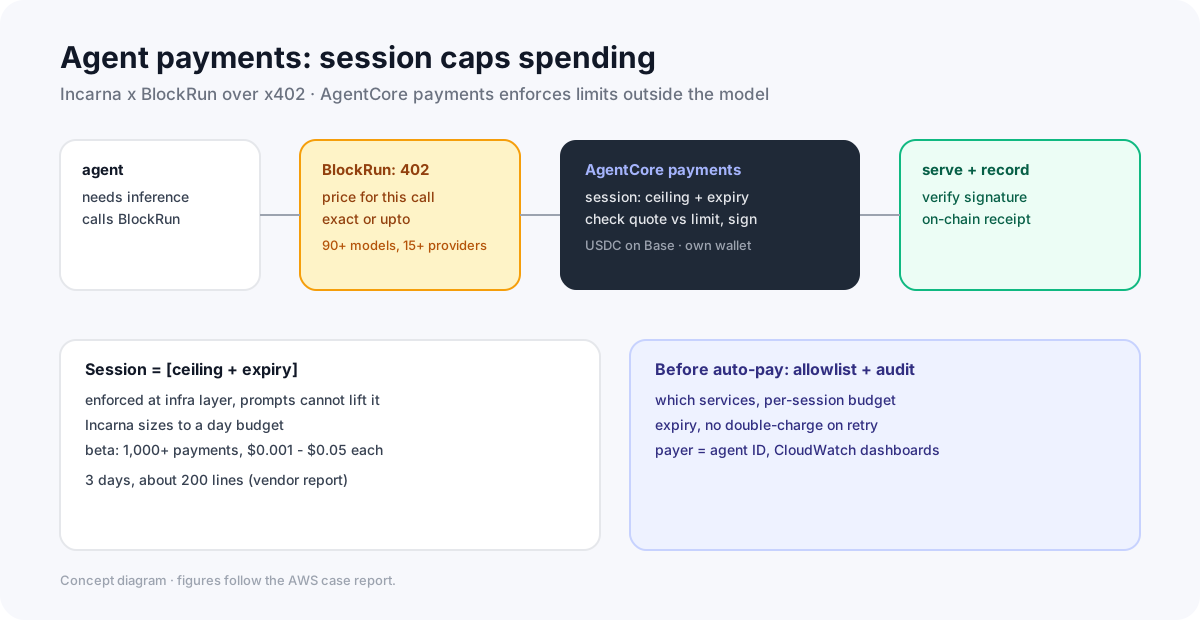
The core split is simple. Agents decide what to buy, infrastructure caps spending, and chains plus logs keep receipts.
Why card rails do not fit
Imagine charging $0.001 to a card 1,000 times. Card networks were not built for high-frequency sub-cent payments. Building your own rails piles up hard problems at once.
- Where is the money held, and how is each payment signed
- How do you support new protocols like x402
- Who stops an autonomous agent from overspending
- Where does an auditable record live
AgentCore payments answers with a managed capability covering protocol handling, wallet connection, transaction signing, and spending-limit enforcement. Attach a Coinbase CDP or Stripe Privy wallet and wire it in a few lines of code.
Incarna x BlockRun: quote each call, settle each call
Three actors. The buyer Incarna agent, the seller BlockRun inference router, and AgentCore payments holding wallets, limits, and signing in the middle. BlockRun bundles 90-plus models from 15-plus providers behind one metered endpoint, quoting and settling each call independently.
Agent -> inference request to BlockRun
  -> BlockRun: HTTP 402 + per-call price
  -> AgentCore payments: opens payment session, calls ProcessPayment
     · checks quote against session limits
     · signs from the agent wallet address
  -> Seller: verifies signature
  -> Serves inference + records charge (USDC on Base)
The customer owns the wallet and delegates use to Incarna, so charges never land on a shared platform key. The on-chain payer is the agent's own identity. Incarna, built by SpreadX, attaches wallet, mail, and action history to a durable ID across sessions, models, and runtimes. Every payment stays attributable.
Two pricing schemes exist. Exact when the price is known up front, upto when pricing is dynamic like token usage. Authorize a ceiling and settle actual usage beneath it. AgentCore payments also supports the Machine Payment Protocol co-authored by Stripe and Tempo, alongside x402.
The operations core: define the payment session first
Agents can hold real money because of payment sessions. Each session carries a ceiling and an expiry, and Incarna sizes them to a day's budget. Broken agent logic still cannot spend past the customer-set limit. Prompt manipulation cannot lift it because limits are enforced outside the model.
Decide these four before wiring auto-pay. This unpacks the briefing's action item.
1. Per-service allowlist: which paid endpoints may be charged
2. Session budget: ceiling and expiry, start small and fit to workload
3. Duplicate protection: retries and timeouts must not double-charge one call
4. Audit log: reconcile on-chain records with CloudWatch and dashboards
The build path is public. Via the payments skill in the Agent Toolkit or the CLI and SDK: create a Payment Manager, connector, and embedded-wallet instrument, then the user funds it and approves signing delegation. The Incarna team finished the full integration in three days: one to build, two to test, about 200 lines of app code, against two to three months originally scoped. Treat those as AWS-reported figures and re-measure in your own setup.
Observability comes attached. CloudWatch logs and prebuilt dashboards track success rate and average value across agents, sessions, and time. This extends the token-to-outcome tracing from the agent KPI post all the way to money.
CodeBridge Mini Lab: test on a virtual budget first
Money-moving agents live or die by test order.
1. Per-request pricing: log the 402 challenge and quote from paid endpoints
2. Approval limits: size session ceilings and expiries to the workload, start small
3. Duplicate protection: confirm retries do not double-charge one call
4. Attribution: confirm the payer is the agent ID, not a shared key
5. Audit: reconcile on-chain records with observability dashboards
This is the approval layer from the agent security guide applied to money. Stop when reversal is hard. For cost yardsticks, read this with the cost-per-successful-task post.
Conclusion: when autonomy reaches buying, control moves to infrastructure
One line to keep:
Once agents can buy for themselves, limits, auth, and audit belong to the platform, not the model.
The case shows a usable split, not a distant future. Agents decide what to buy, infrastructure caps spending, the chain keeps receipts. Before wiring payments, define the allowlist, session budget, expiry, and audit log. That is the minimum safety gear for the self-buying era.
Further reading
- When AI Agents Pay Per API Call: AgentCore Payments and x402
- AI agent KPIs: from tokens to outcomes
- AI agent security primer: why execution needs permissions
References
- AWS: Pay-per-inference for AI agents — How BlockRun and Incarna use Amazon Bedrock AgentCore payments (Oct 8, 2026)
- AWS: Amazon Bedrock AgentCore payments is now generally available (Aug 18, 2026)
- AWS Docs: AgentCore payments how it works
- AWS Docs: AgentCore payments getting started
- BlockRun: Amazon Bedrock AgentCore Payments, the sell side of x402
Go deeper with a course
If you want to design agent loops with repeated execution and verification plus budget, approval, and audit controls, the hands-on agent-structure path connects directly to this post's payment-session story.