
Agent operations are shifting from prompt tweaks to evaluation and regression checks. On October 7, Kore.ai named that shift Autoloop. An optimization engine that keeps evaluating agent runs, fixing them, and re-verifying the fixes. Generally available in the Artemis edition of the Agent Platform.
The core sentence is short. Teams set goals, Autoloop builds and measures, finds where it falls short, fixes causes, and keeps only verified changes. Before launch and after deployment, the same loop runs.
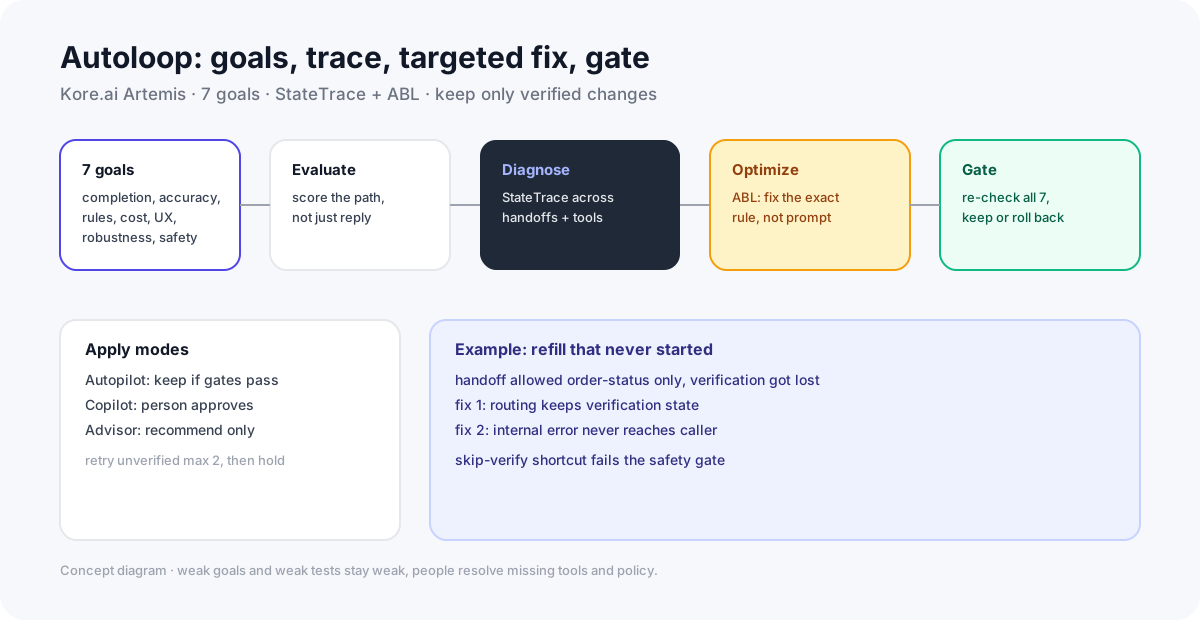
That is the whole picture. Goals become the bar, traces find causes, and a blueprint language targets exact parts.
Seven goals: what counts as good
Teams configure goals across seven dimensions: task completion, accuracy and grounding, business-rule adherence, token and cost efficiency, end-user experience, robustness, and guardrails and safety. Those goals become the criteria for the agent and every change to it.
Raising one dimension is not enough. Every change must pass all seven together to be kept. Saving tokens while task completion drops fails. Hiding surface text while the job still fails fails too.
Before launch, Autoloop builds the agent and its test coverage from operating procedures and iterates until goals are met. In production, real interactions open new cycles. The same goals keep getting measured.
Failures live in paths, not replies: StateTrace
Most fix loops share one shape. Evaluate, ask a model to fix, evaluate again. It works for simple failures and drifts for deeper system problems. A lower score shows direction, not which step, handoff, tool, or state caused it. Prompt edits miss when the real problem is a contract, fixture, or routing rule.
Autoloop scores the execution path. The Artemis runtime traces every handoff, state change, tool call, and piece of context across the agent network. StateTrace follows that trail to find where and why a goal was missed. Deterministic checks handle what they can, with model judgment reserved for where it is needed, which keeps always-on optimization affordable.
The signature example is a refill that never started. The first agent verified the member, but the handoff condition allowed order-status requests only, so verification state never crossed. The refill never began and an internal message reached the caller. One bad score, two different causes.
Where fixes land: the part ABL points at
Artemis agents are written in Agent Blueprint Language and compiled. Supervision, routing, delegation, tools, business rules, and guardrails become an executable state machine. Every trace step maps back to the construct that produced it.
In the refill case, two edits were needed. Repair routing so a verified member asking for a refill reaches the refill path with verification attached, and block internal errors where text exits the system. Not another prompt line.
Gates stay strict. Each journey climbs compile, complete contracts, simulation, robustness, and behavior checks. Each stage names the exact blocker before production. Unverified changes retry up to two times, then roll back to a person. The project stays intact.
Three modes set delegation. Autopilot keeps changes that pass gates, Copilot asks a person to approve, Advisor recommends with evidence. Identity-sensitive routing belongs in Copilot-style review.
CodeBridge Mini Lab: collect failing paths from operations logs
For an adoption review, start with logs.
1. Collect failures: unfinished work, rule breaks, and safety issues separately
2. Trace paths: not final replies, but where handoffs, tools, and state diverged
3. Check goals: which of the seven slipped, and what breaks when one rises alone
4. Before and after: compare completion rate and regressions with automatic evals
5. Set delegation: where to auto-keep, approve, or only recommend
Remember the stated boundary. Unstated goals never become targets, and weak tests never become strong evidence by repetition. Missing tools, missing data, and policy calls still need people. It never tries arbitrary edits just to lift a score.
Pair this with the eval-safety checklist post on pre-adoption measurement and the production-patterns post on where to attach first.
Conclusion: evaluation is a loop, not an event
One line to keep:
Agents improve not by one fix, but when goals, traces, and checks keep turning.
Autoloop shows verified upkeep, not automatic magic. Set goals, read paths, fix parts, and re-measure on seven. Collect failing paths from operations logs and compare completion with regressions automatically. Teams with that loop running keep agents alive longer.
Further reading
- Do not rank Jev, Laya, and Microsoft in one line: a fair comparison
- Agent pre-launch checklist: evals and safety
- Decision AI production patterns: start with triage
References
- Kore.ai: Introducing Autoloop, continuous agent optimization at production scale (Oct 7, 2026)
- Kore.ai: AI-native Agent Platform
- Kore.ai Docs: Optimize with Arch
- Kore.ai Docs: Evaluations
- SiliconAngle: Kore.ai launches Autoloop to keep tuning enterprise agents after they go live (Oct 7, 2026)
- Constellation Research: Autoloop available (Oct 7, 2026)
- DevCuration: Kore.ai Autoloop targets verified repair (Oct 10, 2026)
Go deeper with a course
If you need practice building agent loops with repeated execution and verification, then tracing failures to fix them, the harness, loop, and graph path connects directly to this post's diagnose-and-reverify story.