
A support service may read the same customer history twice: once to decide a refund action and again to assess urgency. Flide targets that repeated work. The first adoption question is whether sharing computation preserves the answers the service would obtain from separate requests.
The official README advertises up to 9.5× acceleration. Its live model table, checked November 9, already contains individual cells above that headline. Treat the headline and a changing table as versioned evidence, rather than a single immutable benchmark. This article reviews sources and interfaces; it does not reproduce GPU measurements.
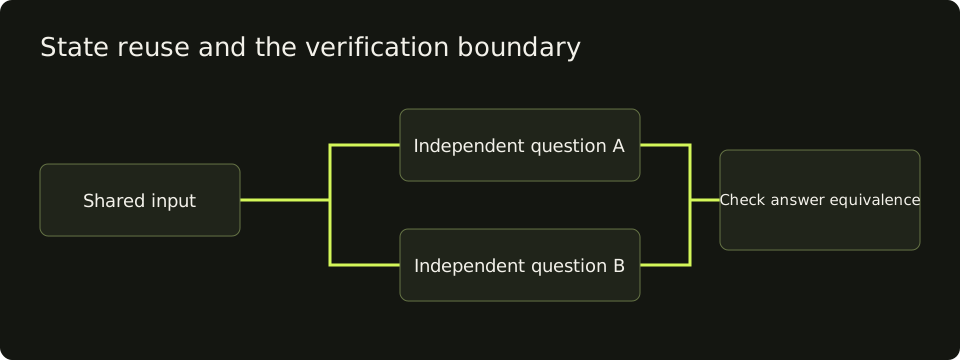
Sharing state without combining the questions
Independent requests repeat processing of a shared record. Putting every question into one prompt avoids some repetition but changes the context each question sees. One question can then influence another.
Exact State Forking is presented as sharing computation for the state while retaining the answer each question would produce alone. That is a behavioral contract. A changed policy version or image preprocessing configuration can change what counts as equivalent input.
Customer record → shared state ┬→ refund question → choice
                               └→ urgency question → decision
This original conceptual diagram does not describe allocation or kernel scheduling. A useful connection to RAG is to freeze retrieved evidence before asking several decision questions. Reusing that state does not establish that the retrieved evidence is correct.
ForkAttention in the Flide paper, Section 3, represents a request as a shared trunk and independent branches. Token-mixing layers must expose the trunk while isolating sibling branches. This applies both to standard attention and to recurrent layers such as Gated DeltaNet, which fold history into a matrix state. That boundary distinguishes the proposal from simply caching a prefix. The paper's equivalence guarantee is stated in exact arithmetic; batch-dependent floating-point bits remain a separate question.
Read the denominator before the multiplier
| README condition | What it does not establish |
|---|---|
| One H200; median request latency per workload | Concurrent-service p95 or throughput |
| Chat models use the faster of vLLM and SGLang | A single baseline across every row |
| OneJev uses its previous qev engine | A vLLM comparison for OneJev |
| KnowLine 35B uses FP8 | Precision-independent performance |
| ~ averages tested sizes | A measurement for one model size |
These are developer measurements, without an independent reproduction here. Pin versions, question count, state length, warm-up and concurrency before comparing deployment candidates. Better median latency can coexist with worse memory pressure or tail latency.
Establish an equivalence test first
The quick start accepts state and named questions at /v1/systemone. This illustrative JSON uses the documented choice and noul types. It has not been submitted to a server.
{
  "state": "Order arrived with a cracked screen.",
  "questions": {
    "action": {
      "type": "choice",
      "instructions": "What should support do next?",
      "criteria": {"replace": "send a replacement", "escalate": "ask a human"}
    },
    "urgent": {"type": "noul", "instructions": "Does this need a reply within the hour?"}
  }
}
A CUDA environment and a review of the chosen model's license precede installation. No model was downloaded or executed for this article. Preserve independently computed reference answers, then vary question order, batch composition and repeated runs. The README's flide verify is a starting point. Its separate --batch-invariant option promises batch-independent bits at a speed cost. Do not infer default bitwise invariance from the word “Exact.”
What changed on November 9
The news log records multiple requests in one body in 0.1.9, then Ainvest, Darwin and KnowLine additions plus KnowLine image support in 0.1.10. These updates are distinct from the October 24 initial release. Image support remains model-specific.
Long shared state and several questions make a reasonable evaluation candidate. Single questions, constantly changing state or unsupported models may offer little benefit or prevent adoption. Model errors and bias remain. Require answer-equivalence checks first, then compare latency, memory and cost under the actual service workload.